
No products in the cart.

How Can You Choose the Right Power Surfboard for Recreational and High-Speed Riding?
Choosing an electric hydrofoil surfboard requires balancing speed, endurance, and safety. Therefore, riders often face complex choices when evaluating key technical specifications. Selecting the correct board directly impacts your overall water experience.
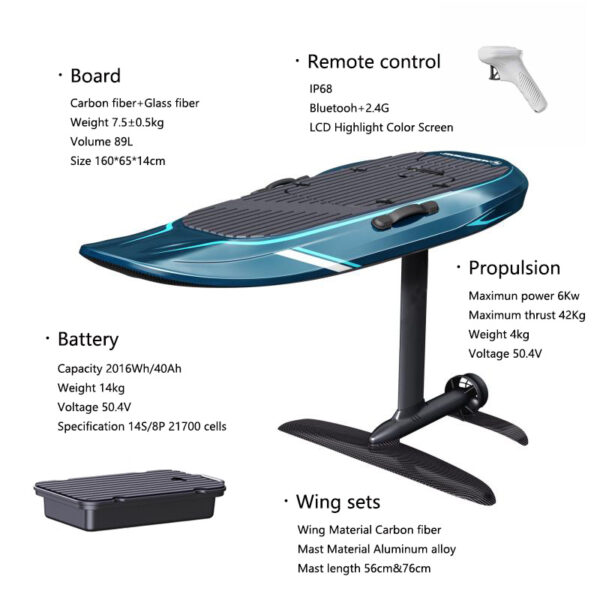
Common Pain Points in Power Surfboard Selection
First, many riders experience unexpected battery depletion mid-session. Standard boards often offer short ride times under heavy loads. Thus, long-distance touring becomes risky without sufficient energy reserves.
Second, maintaining balance at higher speeds can create serious control issues. Standard drive units sometimes deliver jerky acceleration. Consequently, smooth maneuvering becomes challenging during sharp turns.
Third, motor overheating frequently reduces performance during prolonged high-speed sessions. Thermal stress strains electrical components over time. Hence, robust protection systems remain essential for equipment longevity.

Advanced Technical Solutions for High-Performance Surfing
The H5-Pro Fiber Glass Hydrofoil Surfboard addresses these engineering challenges through advanced system integration. For comprehensive product options, you can check our electric surfboard product category page.
The H5-Pro features a 2 kWh battery capacity with a 14S/8P configuration. This setup provides up to 120 minutes of continuous ride time. Furthermore, riders can achieve a maximum travel distance of 30 km on a single charge.
Power delivery relies on a 3.5 kW nominal motor with 6 kW maximum output. Operating at 50.4 V nominal voltage and 120 A maximum current, it reaches top speeds of 50 km/h. Moreover, the lightweight 30 kg glass fiber hull supports rider weights up to 100 kg smoothly.
Control precision stems from a Field Oriented Control (FOC) drive system using CAN communication protocols. Additionally, built-in safeguards include active over-temperature, over-current, and over-voltage protection mechanisms. For deeper setup insights, explore our technical guide for hydrofoils today.
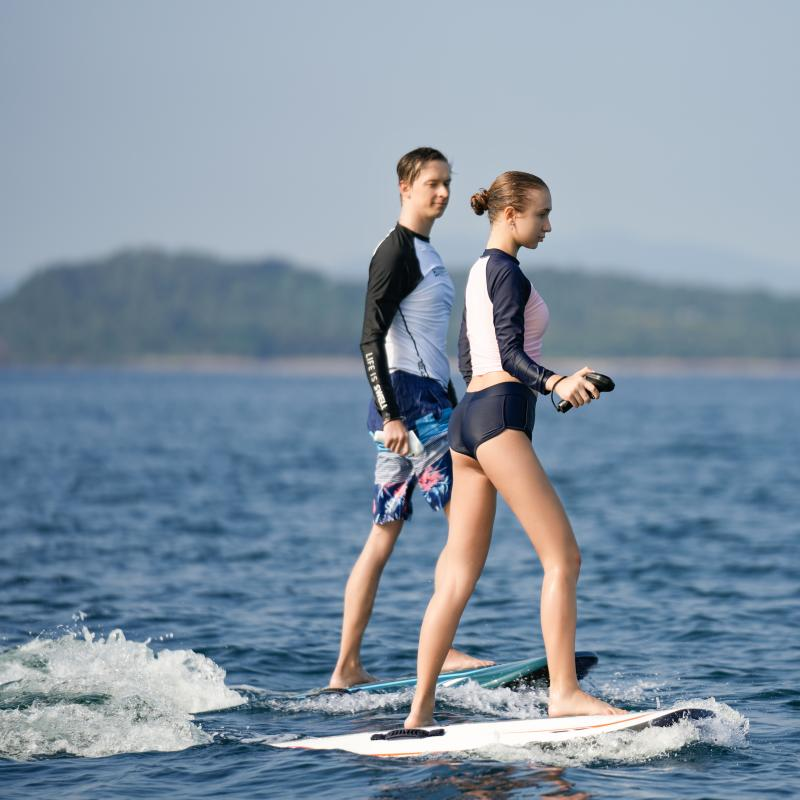
Technical Specifications and Capability Standards
The table below highlights core operational parameters for popular riding configurations.
| Parameter | Standard Recreational Use | High-Speed Performance Use | H5-Pro Fiber Glass Specification |
| Max Speed | 25 – 35 km/h | 40 – 50 km/h | 50 km/h |
| Run Time | 45 – 60 mins | 60 – 90 mins | Up to 120 mins |
| Nominal Power | 1.5 – 2.5 kW | 3.0 – 5.0 kW | 3.5 kW (6 kW Max) |
| Drive Architecture | Scalar / Basic PWM | Advanced Vector / FOC | FOC Drive with CAN |
| Board Dimensions | Compact (140 cm) | Mid-size (160 cm) | 160 x 65 x 14 cm |
| Max Payload | Up to 80 kg | Up to 90 kg | Up to 100 kg |
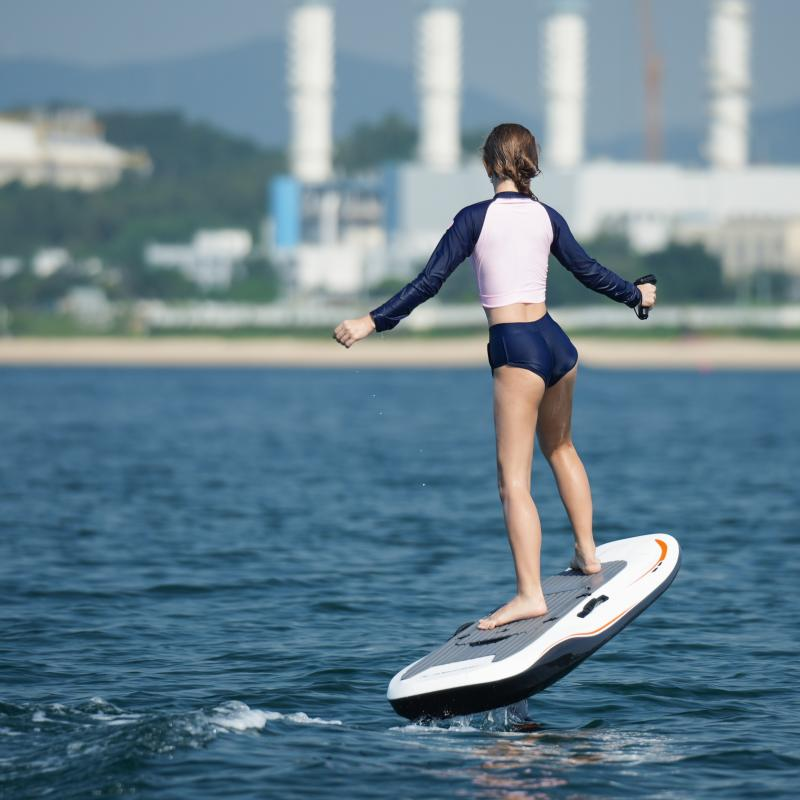
Frequently Asked Questions
Q: How can you choose the right power surfboard for long-distance cruising?
A: Look for a high-capacity energy system like the 2 kWh setup on the H5-Pro. This delivers up to 30 km range and 120 minutes of runtime.
Q: Why is FOC drive technology crucial for high-speed stability?
A: FOC drive paired with CAN communication ensures precise torque management. Therefore, acceleration remains smooth up to the 50 km/h maximum speed limit.
Q: What safety features protect the battery during demanding rides?
A: Integrated safety circuits automatically mitigate over-temperature, over-current, and over-voltage risks. Thus, electronic components maintain high operational reliability under load.
About author

Related posts
Deploying a precise electric propulsion motor transforms small watercraft navigation while delivering clean marine propulsion performance. Indeed, modern recreational boating demands efficient energy conversion to...
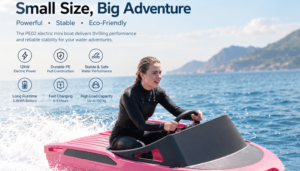
A power board surfboard system completely transforms traditional ocean riding into a high-speed electric adventure. The PE02 HDPE Electric Mini Boat delivers powerful jet propulsion...
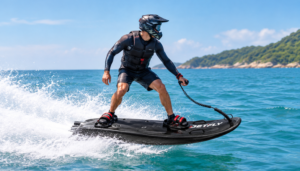
A power board surfboard transforms flat coastal waters into thrilling high-speed aquatic playgrounds. The HS-JF07 SPORT TITANIUM gasoline surfboard delivers unstoppable motor propulsion. Consequently, water...

Deploying an electric jet boat or high-performance personal watercraft turns routine lake vacations into exciting family adventures, boosts marine safety, and cuts fuel operating expenses...
Deploying a portable underwater scooter transforms traditional snorkeling trips, extends dive ranges effortlessly, and eliminates swimmer physical exhaustion in ocean currents. Featuring jet-pump propulsion, nine...
Add comment